.png)
.png) 1 year ago
1 year ago
🎙️ Daily Podcast (FR) : NViNiO•Podcast™
ADs | ✨ Enhance your Social Media content with NViNiO•AI™ for FREE
Today, NVIDIA released a unique language model that delivers an unmatched accuracy-efficiency performance. Llama 3.1-Nemotron-51B, derived from Meta’s Llama-3.1-70B, uses a novel Neural Architecture Search (NAS) approach that results in a highly accurate and efficient model. The model fits on a single NVIDIA H100 GPU at high workloads, making it much more accessible and affordable. The excellent accuracy-efficiency sweet spot exhibited by the new model stems from changes to the model’s architecture that leads to a significantly lower memory footprint, reduced memory bandwidth, and reduced FLOPs while maintaining excellent accuracy. We demonstrate that this approach can be generalized by creating another smaller and faster variant from the reference model.
In July 2024, Meta released Llama-3.1-70B, a leading state-of-the-art large language model (LLM). Today we announce Llama 3.1-Nemotron-51B-Instruct, developed using NAS and knowledge distillation derived from the ‘reference model’ – Llama 3.1-70B.
Superior throughput and workload efficiency
The Nemotron model yields 2.2x faster inference compared to the reference model while maintaining nearly the same accuracy. The model opens a new set of opportunities with a reduced memory footprint, which enables running 4x larger workloads on a single GPU during inference.
| Accuracy | Efficiency | |||
| MT Bench | MMLU | Text generation (128/1024) | Summarization/ RAG (2048/128) | |
| Llama-3.1- Nemotron-51B- Instruct | 8.99 | 80.2% | 6472 | 653 |
| Llama 3.1-70B- Instruct | 8.93 | 81.66% | 2975 | 339 |
| Llama 3.1-70B- Instruct (single GPU) | — | — | 1274 | 301 |
| Llama 3-70B | 8.94 | 80.17% | 2975 | 339 |
Note: Speed is reported in tokens per second per GPU, Measured on machines equipped with 8 X NVIDIA H100 SXM GPUs, with FP8 quantization using TRT-LLM as runtime engine. For each model with the optimal number of GPUs via tensor parallelism (unless otherwise stated). The numbers in the brackets show the (input/output sequence lengths).
See detailed performance metrics below.
Optimized accuracy per dollar
Foundation models display incredible quality in solving very complex tasks — reasoning, summarization, and more. However, a major challenge in the adoption of top models is their inference cost. As the field of generative AI evolves, the balance between accuracy and efficiency (directly impacting cost) will become the decisive factor in model selection. Moreover, the capability to run a model on a single GPU significantly streamlines its deployment, opening opportunities for new applications to run anywhere, from edge systems to data centers to the cloud, as well as facilitating serving multiple models via Kubernetes and NIM blueprints.
Consequently, we engineered Llama 3.1-Nemotron-51B-Instruct to achieve this optimal tradeoff. The tradeoff is captured by the figure below, which shows the accuracy vs. throughput of the leading open source models. Throughput is inversely proportional to price, hence the best tradeoff is obtained by models on the efficient frontier displayed in the figure. As the figure shows, the model pushes beyond the current efficient frontier, making it the model which provides the best accuracy per dollar.
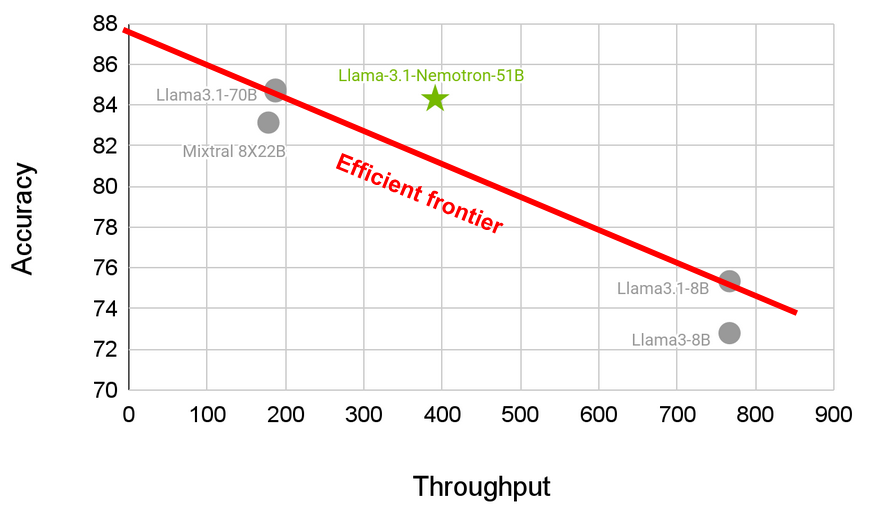 Figure 1. Accuracy vs. Throughput performance of Llama-3.1-Nemotron-51B compared to frontier models. Throughput was measured through NIM with concurrency 25 (serving throughput).
Note: The model quality is defined as the weighted average of MT-Bench and MMLU (10*MT-Bench + MMLU)/2, plotted vs. model throughput per a single NVIDIA H100 80GB GPU. Gray dots represent state-of-the-art models, while the dashed line represents the ‘efficient frontier’.
Simplifying inference with NVIDIA NIM
The Nemotron model is optimized with TensorRT-LLM engines for higher inference performance and packaged as an NVIDIA NIM inference microservice to streamline and accelerate the deployment of generative AI models across NVIDIA accelerated infrastructure anywhere, including cloud, data center, and workstations.
NIM uses inference optimization engines, industry-standard APIs, and prebuilt containers to provide high-throughput AI inference that scales with demand.
Try out Llama-3.1-Nemotron-51B NIM through the API from ai.nvidia.com with free NVIDIA credits.
Under the hood – building the model with NAS
Inference and hardware-aware methods for designing neural architectures have been successfully used in many domains. However, LLMs are still constructed as repeated identical blocks, with little regard for inference cost overheads incurred by this simplification. To tackle these challenges, we developed efficient NAS technology and training methods that can be used to create non-standard transformer models designed for efficient inference on specific GPUs.
Our technology can select neural architectures that optimize various constraints from enormous design spaces that include a zoo of non-standard transformer models that can utilize alternative attention and FFN blocks of varying efficiency degrees, up to a complete block elimination in the extreme case.
We then use our block-distillation (Figure 2) framework to train all these block variants for all layers of a (large) parent LLM in parallel. In a basic version of block-distillation, training data is passed through the reference model (also known as a teacher). For each block, its input is taken from the teacher and injected into the matching block of the student. The outputs of the teacher and student for the block are compared and the student block is trained so that the student block mimics the functionality of the teacher block. A more advanced scenario where a single student block mimics multiple teacher blocks is depicted in the right-hand diagram of Figure 2.
 Figure 2. Block-distillation – For blocks of the reference model (blue), we create multiple variants for the ‘student model’ (yellow) that mimic the block-wise teacher functionality.
Next, we use our Puzzle algorithm to efficiently score each alternative replacement “puzzle piece” and search our enormous design space for the most accurate models, while adhering to a set of inference constraints, such as memory size and required throughput. Finally, by using knowledge distillation (KD) loss for both block scoring and training, we demonstrate the potential to narrow the accuracy gap between our model and the reference model using a much more efficient architecture with a tiny fraction of the reference model training costs. Using our methods on Llama-3.1-70B as the reference model, we built Llama-3.1-Nemotron-51B-Instruct, a 51B model that breaks the efficient frontier of LLMs on a single NVIDIA H100 GPU (Figure 1).
The Llama-3.1-Nemotron-51B-Instruct architecture is unique in its irregular block structure with many layers in which the attention and FFN are reduced or pruned, resulting in better utilization of H100 and highlighting the importance of optimizing LLMs for inference. Figure 3 schematically depicts the irregular structure of the resulting architecture and highlights the resulting compute saving, which amounts to the green area in the Figure.
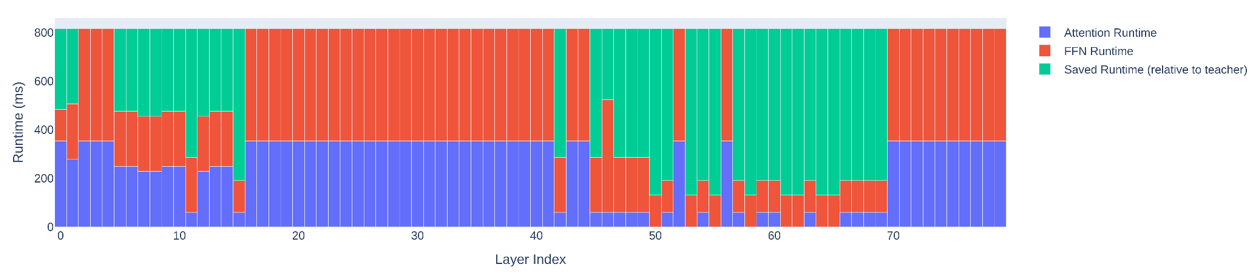 Figure 3. Runtime of Puzzle chosen blocks (layers) for attention layers (blue) and FFN layers (red) across the 80 layers of the reference model. Green areas correspond to overall runtime savings.
Our innovative techniques enable us to develop models that redefine the efficient frontier of LLMs. Crucially, we can cost-effectively design multiple models from a single reference model, each optimized for specific hardware and inference scenarios. This capability empowers to maintain best-in-class performance for LLM inference across our current and future hardware platforms.
Detailed results
Model accuracy
The table below lists all the benchmarks we evaluated – comparing our model and the reference model – Llama3.1-70B. The ‘Accuracy preserved’ is the ratio between our model’s score and that of the teacher.
| Benchmark | Llama-3.1 70B-instruct | Llama-3.1-Nemotron-51B- Instruct | Accuracy preserved |
| winogrande | 85.08% | 84.53% | 99.35% |
| arc_challenge | 70.39% | 69.20% | 98.30% |
| MMLU | 81.66% | 80.20% | 98.21% |
| hellaswag | 86.44% | 85.58% | 99.01% |
| gsm8k | 92.04% | 91.43% | 99.34% |
| truthfulqa | 59.86% | 58.63% | 97.94% |
| xlsum_english | 33.86% | 31.61% | 93.36% |
| MMLU Chat | 81.76% | 80.58% | 98.55% |
| gsm8k Chat | 81.58% | 81.88% | 100.37% |
| Instruct HumanEval (n=20) | 75.85% | 73.84% | 97.35% |
| MT Bench | 8.93 | 8.99 | 100.67% |
Performance
The table below details the number of tokens per second per GPU (H100 80GB). It can be seen that for a range of relevant scenarios – short and long inputs as well as outputs – our model doubles the throughput of the teacher model, making it cost-effective across multiple use cases. TPX describes the number of GPUs on which the process runs in parallel. We also list the performance of Llama 3.1-70B on a single GPU to demonstrate the value of our model in such a setting.
| Scenario | Input/Output Sequence Length | Llama-3.1- Nemotron- Instruct | Llama-3.1-70B-Instruct | Ratio | Llama (TP1) |
| Chatbot | 128/128 | 5478 (TP1) | 2645 (TP1) | 2.07 | 2645 |
| Text generation | 128/1024 | 6472 (TP1) | 2975 (TP4) | 2.17 | 1274 |
| Long text generation | 128/2048 | 4910 (TP2) | 2786 (TP4) | 1.76 | 646 |
| System 2 reasoning | 128/4096 | 3855 (TP2) | 1828 (TP4) | 2.11 | 313 |
| Summarization/ RAG | 2048/128 | 653 (TP1) | 339 (TP4) | 1.92 | 300 |
| Stress test 1 | 2048/2048 | 2622 (TP2) | 1336 (TP4) | 1.96 | 319 |
The main factor in determining the cost of running a model is throughput — the total number of tokens the system can generate in one second. However, in some scenarios (e.g., chatbots), the rate at which a single end user receives the response from the model is important for the user experience. This is quantified by the tokens per second per user, termed the user-side throughput. The figure below shows this user-side throughput, plotted vs. the throughput at different batch sizes. As seen in all batch sizes, our model is superior to Llama 3.1-70B.
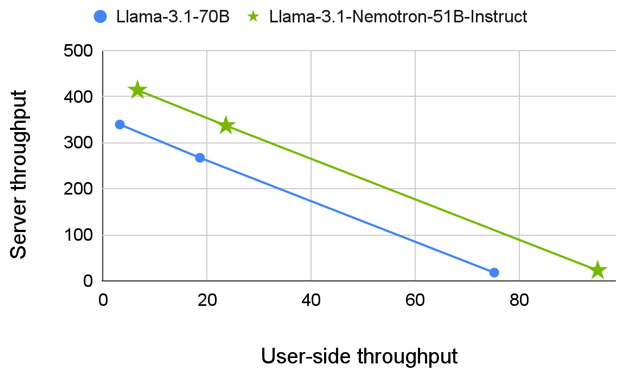 Figure 4. Server throughput vs. user-side throughput, plotted at different batch size for the Nemotron model and for Llama-3.1-70B.
Tailoring LLMs for diverse needs
The NAS approach offers users flexibility in selecting their optimal balance between accuracy and efficiency. To demonstrate this versatility, we created another variant from the same reference model, this time prioritizing speed and cost. Llama-3.1-Nemotron-40B-Instruct was developed using the same methodology, but with a modified speed requirement during the ‘puzzle’ phase.
This model achieves a 3.2x speed increase compared to the parent model, with a moderate decrease in accuracy. Competitive performance metrics are presented in the table below.
| Accuracy | Speed | |||
| MT bench | MMLU | Text generation(128/1024) | Summarization/ RAG (2048/128) | |
| Llama-3.1- Nemotron-40B-instruct | 8.69 | 77.10% | 9568 | 862 |
| Llama-3.1- Nemotron-51B-instruct | 8.99 | 80.20% | 6472 | 653 |
| Llama 3.1-70B-Instruct | 8.93 | 81.72% | 2975 | 339 |
| Gemma2-27B | 8.88 | 76.54% | ADD | ADD |
Summary
Llama 3.1-Nemotron-51B-Instruct provides a new set of opportunities for users and companies that want to use highly accurate foundation models, but do so in a cost-controlled manner. By providing the best tradeoff between accuracy and efficiency, we believe the model is an attractive option for builders. Moreover, these results demonstrate the effectiveness of the NAS approach and intend to extend the method to other models.








 English (United States) ·
  French (France) ·