.png)
 1 month ago
🎙️ Daily Podcast (FR) : NViNiO•Podcast™
ADs | ✨ Enhance your Social Media content with NViNiO•AI™ for FREE
The Pixel Watch 5 offers our most accurate GPS route tracking yet, helping you retrace where you went on runs, hikes, and bike rides.
Lindsey Lanquist
Contributor

Your browser does not support the audio element.
Listen to article
[[duration]] minutes
This content is generated by Google AI. Generative AI is experimental
The new Pixel Watch 5 offers our most accurate GPS route tracking yet. 1 2 “One of the pillars of any smartwatch is fitness,” says Sharath Ananth, a lead engineer on Pixel Watch. “And in fitness, having accurate GPS routes is important.”
When you’re wearing a smartwatch, you want to be able to see exactly where you’ve been during outdoor workouts. Maybe you even want to relive a run, hike, or bike ride you took — remembering that killer hill you climbed or breathtaking waterfall you saw. “If your position is jumpy, it undermines the whole experience,” says Frank van Diggelan, a distinguished engineer on the Precision Location team.
The two worked together, alongside their teams, to develop a watch that has our most accurate GPS route tracking yet — outperforming the Apple Watch Ultra 3 and Garmin Fenix 8 Pro. 3
Naturally, getting there took a lot of work. Here’s a behind-the-scenes look at that journey.
Fixing common GPS problems
To figure out where you are, GPS measures how long it takes a satellite radio signal to reach your device — and multiplies that by the speed of light. It then combines measurements from a few different satellites to pinpoint your location. But lots of things — like atmospheric conditions, nearby buildings, and satellite errors — can throw that calculation off.
Frank’s team had already worked on fixes for other Alphabet products, and they modified those solutions for the Pixel Watch 5.
Thanks to Google Maps, they had three-dimensional models of buildings around the world. And the team paired that data with AI to cut down on errors caused by the GPS signal bouncing off buildings. “You need to know where all the buildings are,” Frank says. “But you also need really good AI to do it right.”
In urban settings, GPS signals can reflect off buildings, making it harder for your device to understand where you are.
The team also tapped Google’s existing network of GPS reference stations across the globe. These stations measure GPS signals, account for discrepancies, and serve that data to Google products in real time. This helped them cut down on inaccuracies from atmospheric conditions and satellite errors.
“We achieved very nice results by combining fixes we’d developed before with new technology,” says Imad Fattouch, a software engineer on the Precision Location team.
Fitting the solution into a smartwatch
Solving these common GPS errors was only the first step — roughly a third of the work, in Sharath’s estimation. The bigger challenge was fitting that solution into a smartwatch.
It’s challenging to build GPS capabilities into a smartwatch for a few reasons. For one thing, smartwatches have small antennas. That makes it hard to get a strong signal from the satellites GPS relies on. “The hardware just limits you,” explains Mark Wheatley, a software engineer on the Pixel Watch team.

Battery life is also a problem. Since smartwatches are small, they have small batteries. And accurate GPS route tracking requires a lot of data — especially when you’re compensating for a smartwatch’s small antenna.
The team needed a way to handle lots of data without sacrificing the watch’s battery life. Their solution? Compressing the watch’s raw GPS data, sending it to a server to get processed and corrected, and delivering it to the Google Health app back-end. (And for the record, the Pixel Watch 5’s battery life wasn’t negatively affected by this change.) 4
Putting the new GPS to the test
The team had their solution, but they needed to ensure it worked across the world — in open air, under tree cover, and in urban environments. So they sent testers out wearing up to four different types of smartwatches and a special backpack equipped with a massive antenna.
“We’ve sent people to different cities,” Sharath says. “We’ve sent them to different countries.” The testers walked, ran, and biked thousands of miles.
Their findings were almost unbelievable. “Imad showed me the results,” Mark says. “And I was like, ‘Are you sure you haven’t leaked ground truth?’” Ground truth is the team’s control data — essentially, the route the tester actually took. The Pixel Watch 5 route was similar enough to the ground truth route that Mark worried a glitch had caused the wrong data to show up. It hadn’t.
“That solution we were building? It worked,” says Frank.
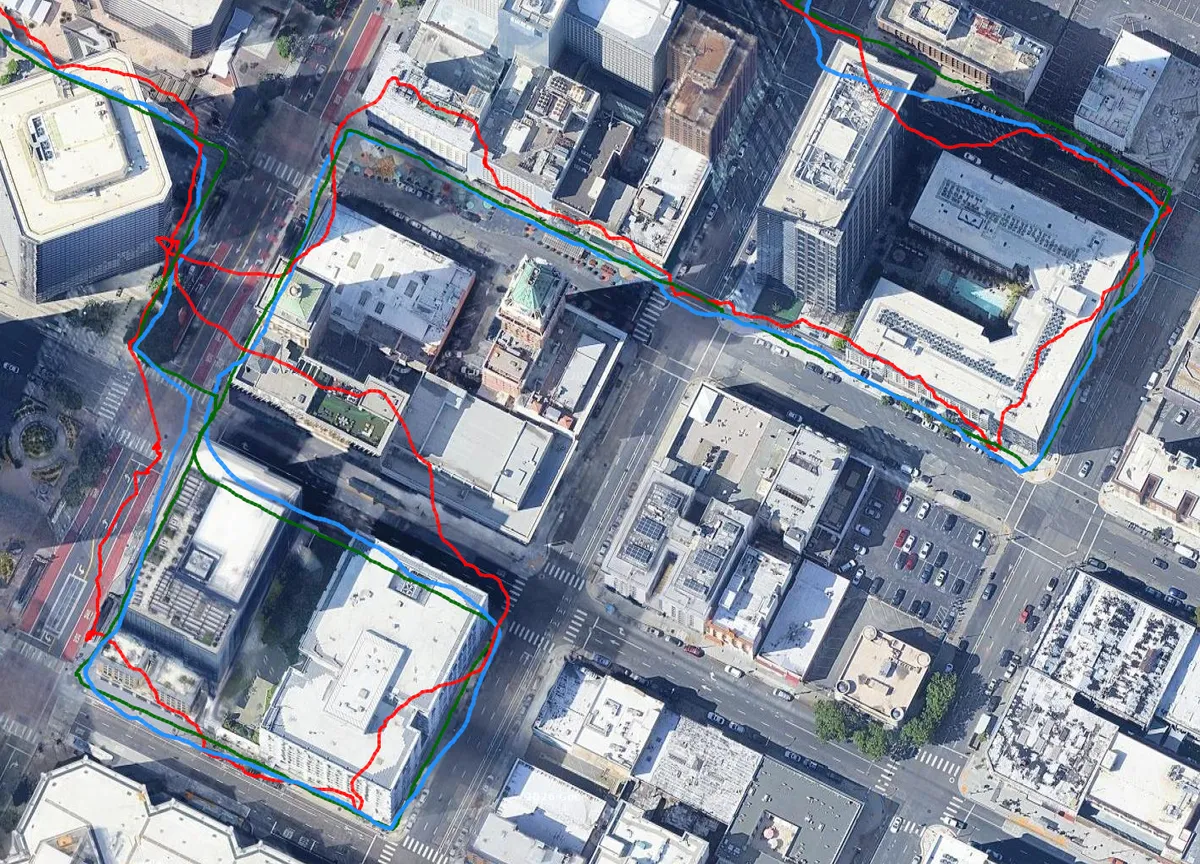
Here are some results from the team's GPS route tracking tests. Pixel Watch 4's route is red, Pixel Watch 5's route is blue, and the ground truth route is green.
Pixel Watch 5 is available for preorder starting August 12 and will be on shelves August 20, starting at $399 (41mm) and $429 (45mm).
Get the latest news from Google in your inbox
Sign up for our newsletters with product updates, event information, special offers, and more.
Your information will be used in accordance with Google's privacy policy. You may opt out at any time.









 English (United States) ·
  French (France) ·