.png)
 4 weeks ago
The top 15% of AI users report stronger performance reviews, pay increases and substantial time savings. The challenge now is upskilling the remaining 85% to enable everyone to use AI to unlock personal progression.

Kate Alessi
Vice President and Managing Director, Google UK & Ireland

The UK’s AI adoption: fast, but uneven
We’ve worked with Public First on one of the most comprehensive UK AI adoption studies to date. The research reveals that workplace AI adoption has doubled in the past year, (up to 73%, from 34% in 2025). Yet, this momentum reveals an uneven adoption curve, where only a minority - the top 15% - are significantly more likely to report promotions, pay rises and faster career progression.

Our analysis reveals that AI usage is a spectrum, with most of the UK’s workforce still stuck in early-stage adoption. We’ve segmented the workforce into four progressive stages:
‘AI Spectators’ (10%) - People who aren’t yet experimenting with AI‘AI Experimenters’ (38%) - Beginners testing the waters with simple tasks‘The AI Practitioners’ (37%) - Intermediates using AI as a reliable daily tool.‘AI Trailblazers’ (15%) - Advanced users pushing boundaries and finding entirely new ways to work.The AI Trailblazer advantage
The UK’s AI Trailblazers are creating a new benchmark for modern work and saving almost 8 hours across both their personal and professional lives - effectively gaining an extra day each working week.
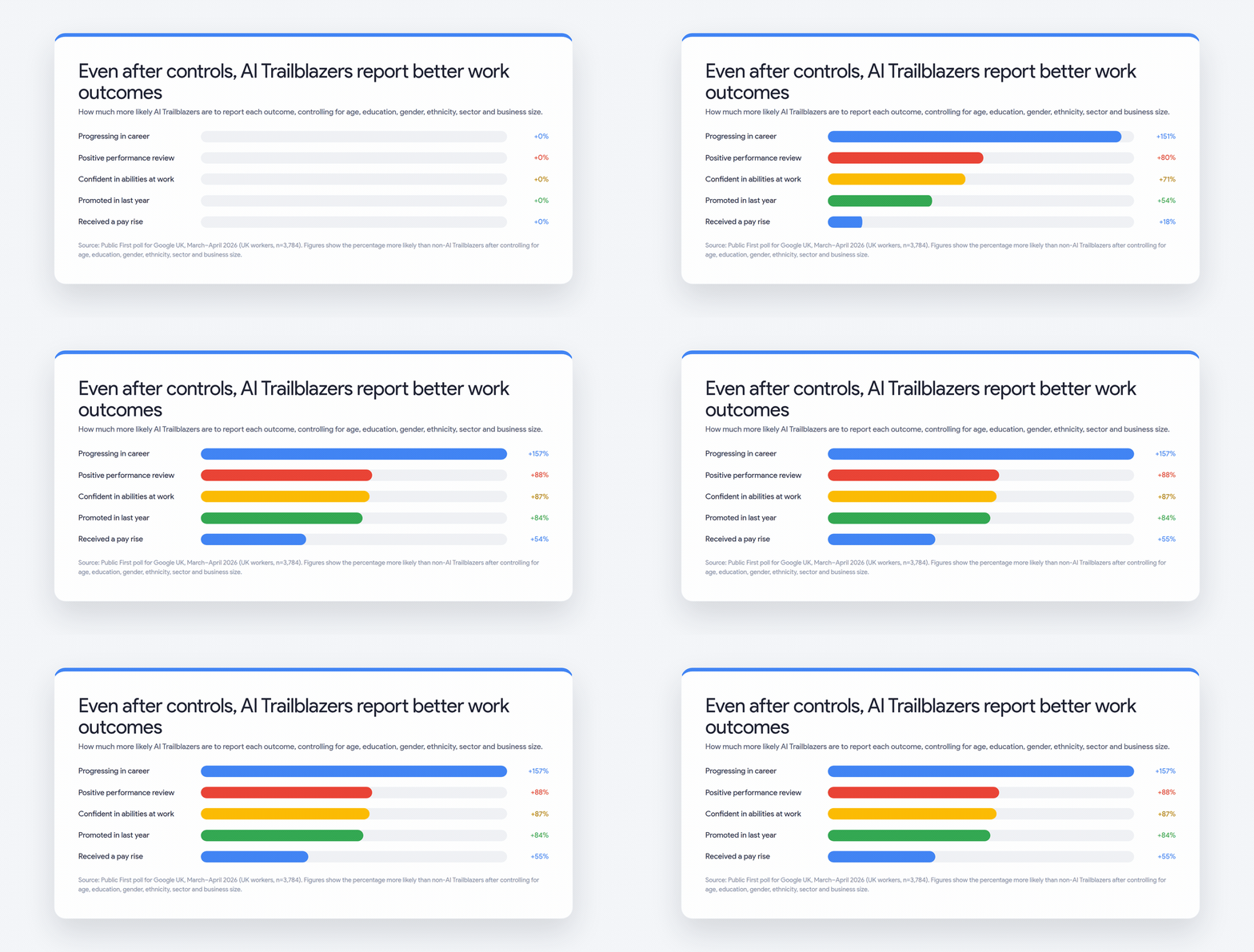
The research found that even after accounting for differences in age, sector, gender, ethnicity, education and business size, deeper AI use is associated with greater professional momentum. Trailblazers are:
84% more likely to have been promoted in the past year.88% more likely to achieve a positive performance review.55% more likely to secure a pay rise.But, this deeper AI use is unevenly spread across age groups, genders and geographical location. The longer we wait to take action the more that this gap will grow.
The good news is that these disparities are entirely addressable. Reaching this advanced level doesn't require deep technical knowledge or coding expertise. Anyone can become a Trailblazer.
Breaking down the barriers
The real challenge is converting everyday experimentation into a level of AI literacy that unlocks career progression and, in turn, nationwide economic growth.
So, how do we help the other 85% unlock these benefits? The barriers holding people back are surprisingly easy to overcome, with collective focus. They are, for the most part, either behavioral, cognitive or organisational:
Behavioral - The "One-and-Done" habit: Most casual users haven’t gotten into the habit of using AI effectively. Many aren’t yet iterating prompts, matching the right tool to the task, or are unsure of how to get started with multi-modal capabilities (text, visual, and audio inputs and outputs) and agentic workflows (where AI autonomously plans and executes multi-step tasks).Cognitive - The traditional "Search Box" mindset: Millions of users naturally apply their familiar search habits to AI tools, instead of treating it as a creative partner. Despite AI's highly collaborative nature, only 37% of previous users have ever asked an AI to help them write a better prompt to quickly achieve more effective results.Organisational - The "Permission to Prompt" gap: Many workers are waiting for explicit permission to use AI. Only one-third of AI users have clear professional guidance to help them use AI confidently, and fewer than half know who to ask about responsible use.Building a nation of AI Trailblazers
Levelling up starts with knowing where you stand. That’s why today, Public First is launching the AI skills quiz, an interactive diagnostic tool that lets you benchmark your skills against the rest of the population, learn more about the type of AI user you are and get actionable skills to instantly elevate your AI use and help unlock career growth.
Our nationwide AI upskilling initiative, AI Works for Britain, aims to tackle this specific uneven adoption challenge, and builds on our Google Digital Garage programme - which has already trained over 1.2 million people over the past decade. This is a key element of our partnership with the Government to help achieve their goal of training 10 million workers in AI skills by 2030. Together, we can close the adoption gap, build a nation of AI Trailblazers, and help every worker unlock their full potential.
The impact of Google’s products and services
One of the most important ways we can enable deeper AI adoption and unlock growth and progression is through helpful AI tools. In 2025, Google’s tools supported £140 billion in economic activity across the UK - equivalent to the economy of Greater Manchester. Over 40% of that activity (£60bn) comes from empowering British SMBs who are using our tools to innovate and grow. Our products such as Search, Android, Cloud and YouTube are already saving British workers 51 million hours a week - roughly the weekly output of the National Health Service’s (NHS) entire workforce.







 English (United States) ·
  French (France) ·